

You don't have to sacrifice a streamlined silhouette for a DOT-certified shell that provides genuine protection on the road. Many riders seek the minimalist freedom of open face motorcycle helmets but find themselves frustrated by the bulky "mushroom head" look caused by thick EPS liners. It's a common struggle to find a lid that stays put without wind lift pulling it back at highway speeds. We understand the need for gear that balances raw, classic style with the rigorous safety standards of 2026.
In this guide, you'll discover how to identify a low-profile, DOT-approved half helmet that fits correctly and looks sharp. We will clarify the differences between FMVSS No. 218 certifications and novelty caps so you can ride with confidence. You'll also learn which models, such as those from Daytona or Sena, offer the best stability and Bluetooth compatibility. From understanding the latest ECE 22.06 updates to finding the perfect fit, we provide the expert insight you need to choose your next helmet with total certainty.
Key Takeaways
- Understand the minimalist design of half-shell helmets and why they remain a staple for cruiser and custom bike culture.
- Learn how to verify DOT FMVSS 218 certification to ensure your open face motorcycle helmets meet mandatory US safety standards.
- Discover the engineering secrets behind low-profile fits that eliminate the bulky "mushroom head" look without compromising protection.
- Evaluate the trade-offs between half-shell and three-quarter styles to find your ideal balance of freedom and coverage.
- Identify top-performing brands for 2026, including Daytona and HJC, that offer superior weight distribution and integrated features.
What is a Half Helmet? Defining the Minimalist Choice for Bikers
A half helmet, often called a "half-shell," represents the most minimalist approach to head protection. This design covers the top of the head from the forehead to the crown, leaving the face and jaw completely exposed. While it offers less coverage than full-face models, it remains a popular choice within the broader category of open face motorcycle helmets. Riders who value a raw, connected experience with the road often gravitate toward this style. It provides the essential protection needed to meet legal standards in most states while maintaining a classic aesthetic.
This style is deeply rooted in cruiser, chopper, and custom bike culture. It's about more than just a piece of gear; it's a statement of freedom. Because it doesn't have a chin bar or a heavy visor, the rider enjoys maximum peripheral vision and unrestricted airflow. This makes it a practical solution for low-speed cruising or navigating scenic routes where visibility is a priority.
To better understand how these designs fit into the market, watch this helpful video:
The Anatomy of a Half-Shell Helmet
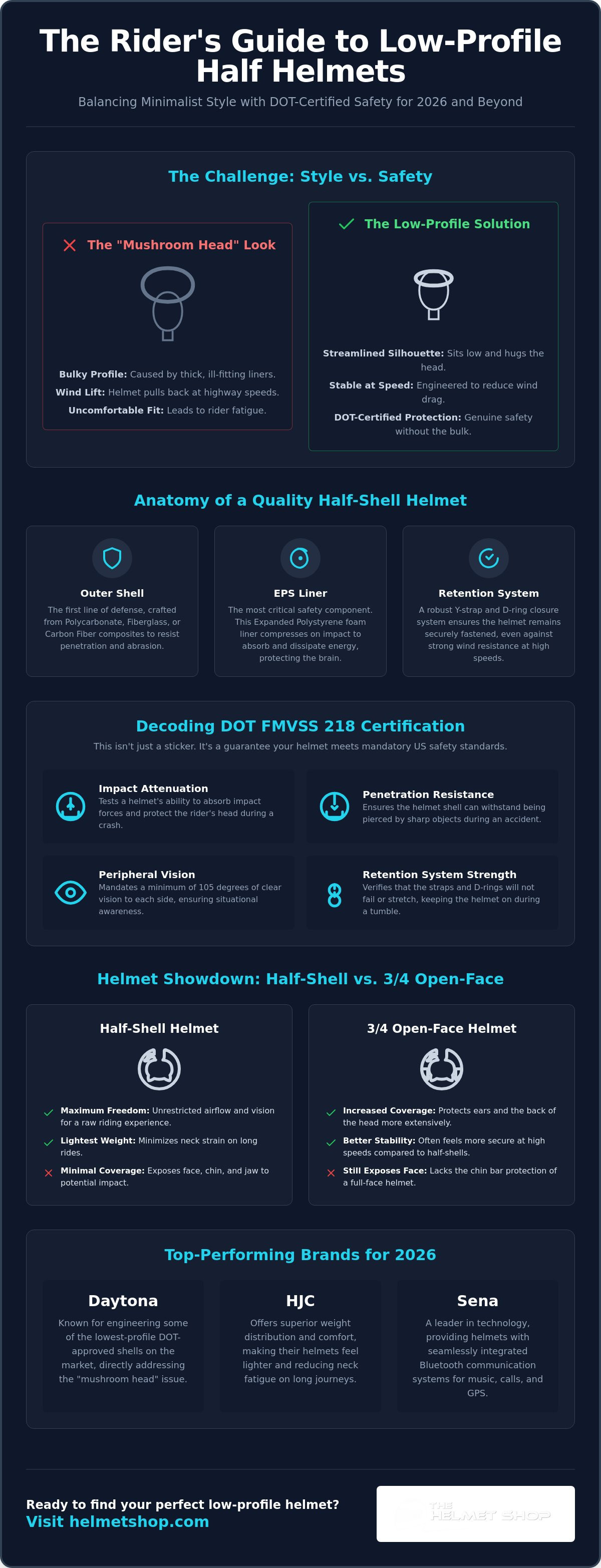
The construction of a quality half-shell is more complex than its small size suggests. Manufacturers typically use high-strength materials like polycarbonate, fiberglass, or carbon fiber composites for the outer shell. Beneath this shell lies the impact-absorbing EPS liner. This layer is the most critical safety component. It's designed to compress during an impact to protect the brain. To keep the helmet secure at high speeds, a robust retention system is used. Most models feature a Y-strap design and a classic D-ring closure. These ensure the helmet stays in place against wind resistance. Different Motorcycle helmet types offer various protection levels, but the internal components of a certified half-shell must still meet strict impact standards.
Why Bikers Choose the Half-Shell Style
The primary draw of this style is the unmatched ventilation. In hot climates, full-face helmets can become stifling. A half-shell allows for constant cooling. This helps prevent rider fatigue during summer months. These helmets are also significantly lighter than modular or full-face alternatives. This reduced weight minimizes neck strain, making long days in the saddle much more comfortable. Many riders prefer these over other open face motorcycle helmets because they provide the most "open" riding experience possible. Additionally, the open design makes it easy to communicate with other riders. You can also wear standard sunglasses or goggles without the interference of a face shield.
Safety Standards: Understanding DOT Certification for Half-Shells
Selecting a half-shell isn't just about achieving a specific look; it's about ensuring your gear meets the legal requirements for road use. In the United States, the Department of Transportation (DOT) sets the mandatory safety standard known as FMVSS 218. Every helmet intended for street use must meet these criteria to be considered legal protection. These DOT helmet safety standards require rigorous testing for impact attenuation, penetration resistance, and peripheral vision. If a helmet fails to provide at least 105 degrees of clear vision on either side, it doesn't pass. This ensures that while you enjoy the breeze, you still maintain the situational awareness necessary for safe riding.
Riders must be wary of "novelty" lids that mimic the appearance of open face motorcycle helmets. These products are often sold with disclaimers stating they aren't for highway use, and for good reason. They lack the energy-absorbing materials found in certified gear. While a genuine half helmet provides a baseline of protection for the top of your head, it's important to recognize the inherent trade-offs. This style provides no coverage for the chin, jaw, or face. Statistics show that a significant portion of motorcycle impacts occur in the chin bar area, which remains exposed in any half-shell design. You're choosing maximum freedom, but you're also accepting higher risk for facial injuries.
How to Spot a Real DOT-Approved Half Helmet
Don't rely solely on a removable sticker. Genuine DOT-certified helmets feature a permanent symbol applied by the manufacturer on the rear of the shell. You should also perform a physical inspection of the interior. A real safety helmet feels substantial and has a thick, firm inner liner. If you can feel the outer shell through a thin layer of soft craft foam, it's a novelty cap. Weight is another major indicator. Because of the required safety components, a certified helmet will always be heavier than a flimsy plastic novelty shell. If you want to ensure you're getting authentic protection, you can browse our collection of certified half helmets to see the difference in construction quality.
The Role of the EPS Liner in Minimalist Helmets
The Expanded Polystyrene (EPS) liner is the most vital part of your helmet's safety system. The EPS liner serves as the primary energy-management component in a motorcycle helmet by absorbing and dispersing force during a crash. When an impact occurs, this high-density foam compresses, slowing the movement of your head and reducing the energy transferred to your brain. Modern advancements in high-density EPS allow manufacturers to create thinner liners that still meet strict safety thresholds. This technology is what allows for a more streamlined fit without compromising your safety on the road. High-quality open face motorcycle helmets use varying densities of EPS in specific zones to maximize protection while keeping the overall profile as low as possible.
Half Helmets vs. 3/4 Open Face: Choosing Your Level of Exposure
Deciding between a half-shell and a three-quarter design is a pivotal choice for riders who favor open face motorcycle helmets. Both styles provide a level of sensory connection to the environment that full-face helmets simply can't replicate. However, the physical differences in their construction lead to distinct riding experiences. While a half helmet offers the ultimate sense of freedom and minimal weight, a 3/4 helmet provides a more substantial barrier against the elements. Data from studies on helmet effectiveness confirms that any certified helmet significantly reduces the risk of serious injury, but the area of coverage directly impacts your comfort and safety during a slide or impact.
Stability at speed is one of the most noticeable differences between these two styles. Half helmets are prone to "wind lift," a phenomenon where air catches the underside of the brim and pulls the helmet upward and backward. This can cause significant neck strain and discomfort during long highway stretches. In contrast, 3/4 helmets wrap around the ears and the base of the skull, creating a more aerodynamic profile that stays planted even at high freeway speeds. This added coverage doesn't just improve stability; it also provides a much quieter ride by blocking a large portion of ambient wind noise.
Coverage and Protection Comparison
A half helmet focuses protection on the crown of the head. It's the lightest option available, but it requires you to manage your own eye protection and weather resistance. You'll need a reliable pair of goggles or sunglasses to shield your eyes from debris and insects. A 3/4 helmet offers a middle ground by protecting the sides and back of the head. Many of these models come equipped with integrated drop-down sun shields or snaps for attaching a full-face visor. For those considering the added security and quietness of a premium three-quarter model, our Shoei helmets guide explores how high-end materials and engineering justify the investment in better coverage.
Riding Environment: City vs. Highway
Your choice should align with where you spend most of your time in the saddle. Half shells are the perfect companion for low-speed city cruising, urban commuting, or attending local bike events. They offer maximum ventilation and are easy to carry when you're off the bike. However, if your journeys involve long hours on the interstate or touring through different states, the 3/4 helmet is often the more practical tool. It handles inclement weather much better and keeps you focused by reducing fatigue from wind blast. If you frequently ride in regions with unpredictable storms, consult our guide on motorcycle rain gear to ensure you're fully prepared for the road ahead. Whether you choose the minimalist half-shell or the more robust 3/4 style, both remain popular open face motorcycle helmets that prioritize a classic aesthetic.
How to Achieve the Perfect Fit and Avoid the Mushroom Head Look
The "mushroom head" look is the most common aesthetic complaint among cruiser riders. It isn't just a matter of personal style; it's a direct result of how a helmet is engineered. This bulky appearance occurs when a manufacturer uses a single, large outer shell for all head sizes. To make that oversized shell fit a smaller head, they must use an excessively thick EPS liner. While this meets safety standards, it creates a top-heavy profile that catches the wind and looks disproportionate. High-quality open face motorcycle helmets solve this problem by using multiple shell sizes. This ensures that a size Small helmet uses a Small shell, keeping the profile as slim as possible.
A proper fit is also your primary defense against wind lift. If your half-shell is even slightly too large, air will catch the front brim at highway speeds. This creates a sail effect that pulls the helmet back, straining your neck and choking you with the chin strap. A correctly fitted helmet should feel snug around the entire circumference of your crown. There should be no "hot spots" or specific points of pressure that cause discomfort after a few minutes of wear. If the helmet can rock side to side or slide forward over your eyes, it's too large for your head shape.
Measuring Your Head for a Half-Shell
Precision is vital because sizing varies significantly between manufacturers. Use a cloth tape measure and wrap it around your head about one inch above your eyebrows. This is the widest part of your head and the most accurate point for helmet sizing. Once you have your measurement in centimeters or inches, compare it to the specific brand's chart. Don't assume an HJC Large will fit the same as a Daytona Large. After you receive your helmet, perform the "roll-off" test. Fasten the strap snugly and try to pull the back of the helmet forward. If it tilts significantly or comes off, the retention system or the shell size is incorrect for your anatomy.
The Secret to Low-Profile DOT Helmets
The secret to a slim fit that remains DOT-compliant lies in shell-to-size ratios and tapered EPS liners. Premium brands invest in more molds so they can offer three or four different shell sizes across their product line. This allows the safety liner to be thick enough to absorb impact without adding unnecessary bulk to the exterior. For riders who prioritize the slimmest possible look, our Daytona helmets guide explains how this brand achieved its reputation for the lowest-profile DOT protection on the market. Selecting the right brand can mean the difference between a sleek, classic look and a bulky, uncomfortable ride.
Ready to upgrade your gear? Find your perfect low-profile fit in our curated helmet collection.
Top-Rated Half Helmets for 2026: Brands That Deliver Performance
Choosing the right brand for your half-shell ensures you get the best balance of safety and comfort. While many companies produce open face motorcycle helmets, only a few have mastered the technical requirements of the minimalist format. Daytona Helmets remains the industry leader for riders who want the lightest, slimmest DOT-approved profile available. Their engineering focuses on minimizing shell size without compromising the density of the impact-absorbing liner. This dedication to a low profile makes them a staple in the cruiser community.
HJC Helmets offers a different value proposition by focusing on integrated features and daily utility. Many of their models include convenient drop-down sun shields, which eliminate the need to swap between clear and tinted glasses as the sun sets. While premium brands like ARAI and Shoei primarily focus on full-face and modular designs, their rigorous engineering standards influence the entire market. Their advancements in fiberglass composites and ventilation systems often set the benchmark that other half-shell manufacturers strive to reach. When comparing options, look for specific performance features that enhance your riding experience:
- Removable Liners: Allows for easy washing to keep the helmet fresh.
- Moisture-Wicking Fabrics: Pulls sweat away from the skin during summer rides.
- Visor Snaps: Provides the flexibility to add a three-snap peak or shield.
Integrating Bluetooth Communication
Adding tech to a minimalist lid presents unique challenges. Since half-shells don't cover the ears, you can't simply tuck speakers behind a cheek pad. Most riders use "ear pocket" strap accessories or specific mounting kits designed for Sena or Cardo units. These accessories wrap around the Y-straps to hold the speakers securely against your ears. This setup allows you to enjoy GPS directions or music without sacrificing the open-air feel of your gear. For detailed installation tips and model recommendations, check our guide on bluetooth motorcycle headsets. It's the best way to stay connected while using open face motorcycle helmets.
Maintenance and Longevity
A helmet is a long-term investment in your safety, but it won't last forever. You should follow the "5-year rule" and replace your helmet every five years from the date of purchase. Over time, the resins in the shell can become brittle, and the EPS liner can lose its ability to compress effectively. Regular maintenance extends the life and comfort of your gear. Clean the interior liner frequently to prevent salt from sweat and oils from your skin from breaking down the materials. Inspect the D-rings and retention straps monthly for any signs of fraying or corrosion. If you've dropped your helmet on a hard surface, replace it immediately. The internal liner may have already performed its one-time job of absorbing an impact, even if the shell looks fine.
Choose Your Perfect Ride with Confidence
Choosing a half-shell doesn't mean you have to settle for a bulky look or questionable protection. We've shown how modern engineering allows you to enjoy the freedom of a minimalist lid while maintaining strict DOT safety standards. The key is focusing on shell-to-size ratios to avoid the mushroom look and ensuring a snug fit to prevent wind lift at highway speeds. Whether you're navigating urban traffic or cruising scenic backroads, open face motorcycle helmets provide a level of sensory connection that defines the riding experience.
As an authorized dealer for Shoei, ARAI, and Daytona, we've carefully selected gear that meets our high standards for reliability and performance. Our expert staff has decades of riding experience and is ready to help you navigate technical specifications or sizing concerns. We provide national shipping on all our premium riding gear so you can get the protection you need delivered right to your door. Browse our curated collection of DOT-approved half helmets today to find a style that fits your ride. Stay safe and enjoy the freedom of the open road.
Frequently Asked Questions
Are half helmets legal in all US states?
Half helmets are legal in any state that permits open face motorcycle helmets, provided they carry a valid DOT certification. In the U.S., 17 states and the District of Columbia currently enforce universal helmet laws. Another 30 states have partial laws based on age or experience, while three states (Illinois, Iowa, and New Hampshire) have no statewide adult requirement as of July 2026. Always check local regulations before you ride.
Can I wear a half helmet for my motorcycle license test?
You can wear a half helmet for your license test if it meets DOT FMVSS 218 standards. Examiners typically verify the DOT symbol on the rear of the shell before the test begins. You must also wear required eye protection, such as goggles or shatterproof glasses, if your state mandates it. Check your local DMV handbook to ensure your specific gear meets their safety inspection criteria.
How do I stop my half helmet from lifting at high speeds?
Preventing wind lift starts with a precise fit and a correctly adjusted Y-strap. If the helmet's too large, air catches the front brim and pulls the shell upward. Look for designs with aerodynamic profiles or integrated fit systems that keep the shell stable. Keeping the chin strap snug against your jaw prevents the "sail effect" during high-speed highway cruising.
What is the difference between a half helmet and a beanie helmet?
The primary difference is safety certification. A "beanie" is often a novelty lid with no protective EPS liner, making it illegal for road use in many jurisdictions. A genuine half helmet is a DOT-certified piece of equipment designed to absorb impact. While they may look similar from a distance, the certified version is heavier and contains the technical layers needed to protect your brain during a crash.
Can you install a Bluetooth headset on a half-shell helmet?
You can install Bluetooth communication systems using specific mounting accessories. Since half-shells lack ear flaps, you'll need "ear pocket" wraps or a headset designed for open face motorcycle helmets. Brands like Sena and Cardo offer kits that attach to the retention straps, positioning the speakers directly over your ears. This allows you to maintain communication without needing a full-face shell.
Do half helmets expire like full-face helmets?
Half helmets have the same five-year lifespan as full-face or modular models. The Expanded Polystyrene (EPS) liner degrades over time due to UV exposure, temperature changes, and hair oils. Even if the exterior looks perfect, the internal safety materials lose their ability to compress and manage energy after five years. Always replace your helmet immediately if it's involved in a significant impact or drop.
What eye protection should I wear with a half helmet?
You should wear shatterproof goggles or wrap-around sunglasses that provide a complete seal against the wind. Since half helmets don't have a face shield, your eyes are vulnerable to road debris, insects, and wind-induced watering. Many states require eye protection by law. Choosing lenses with UV protection and anti-fog coatings'll significantly improve your comfort and situational awareness on the road.
Is a carbon fiber half helmet worth the extra cost?
Carbon fiber is a worthwhile investment for riders who prioritize weight reduction and neck comfort. This material provides exceptional strength while being significantly lighter than traditional polycarbonate or fiberglass shells. A lighter helmet reduces the physical toll of wind resistance during long trips. While it carries a higher price point, the performance benefits in durability and fatigue reduction are clear for serious enthusiasts.


