

What if the most effective safety feature on your motorcycle helmet isn't the foam liner, but the actual curve of the outer shell? While many riders focus on meeting basic DOT or ECE requirements, the Arai R75 shape focuses on the unpredictable physics of a real-world crash. This specific design philosophy uses a continuous curve radius of at least 75mm to ensure the helmet glances off obstacles rather than catching on them.
It's often frustrating to compare complex standards like Snell M2020D and the new ECE 22.06, especially when you're trying to protect yourself from rotational brain injuries. You want to know that a premium investment provides real-world protection, not just a passing grade on a lab test. This article will show you how Arai's unique shell design manages kinetic energy better than traditional, angular helmets.
You'll discover the science of glancing off and how it works alongside modern standards like the FIM FRHPhe-02. We'll break down how the R75 shape mitigates rotational energy, helping you decide if an Arai is the right choice for your safety needs.
Key Takeaways
- Understand why the Arai R75 shape utilizes a specific 75mm curve radius to maximize shell strength and energy redirection.
- Learn the physics behind "glancing off" and how it converts dangerous direct impacts into safer sliding motions.
- Discover how a rounder shell design naturally mitigates rotational forces, which are a primary cause of concussions.
- Explore why Arai prioritizes functional safety over aggressive styling and how this choice protects you in real-world scenarios.
- Identify the best helmet for your specific head shape by comparing the internal fitment of models like the Corsair-X and Signet-X.
What is the Arai R75 Shape?
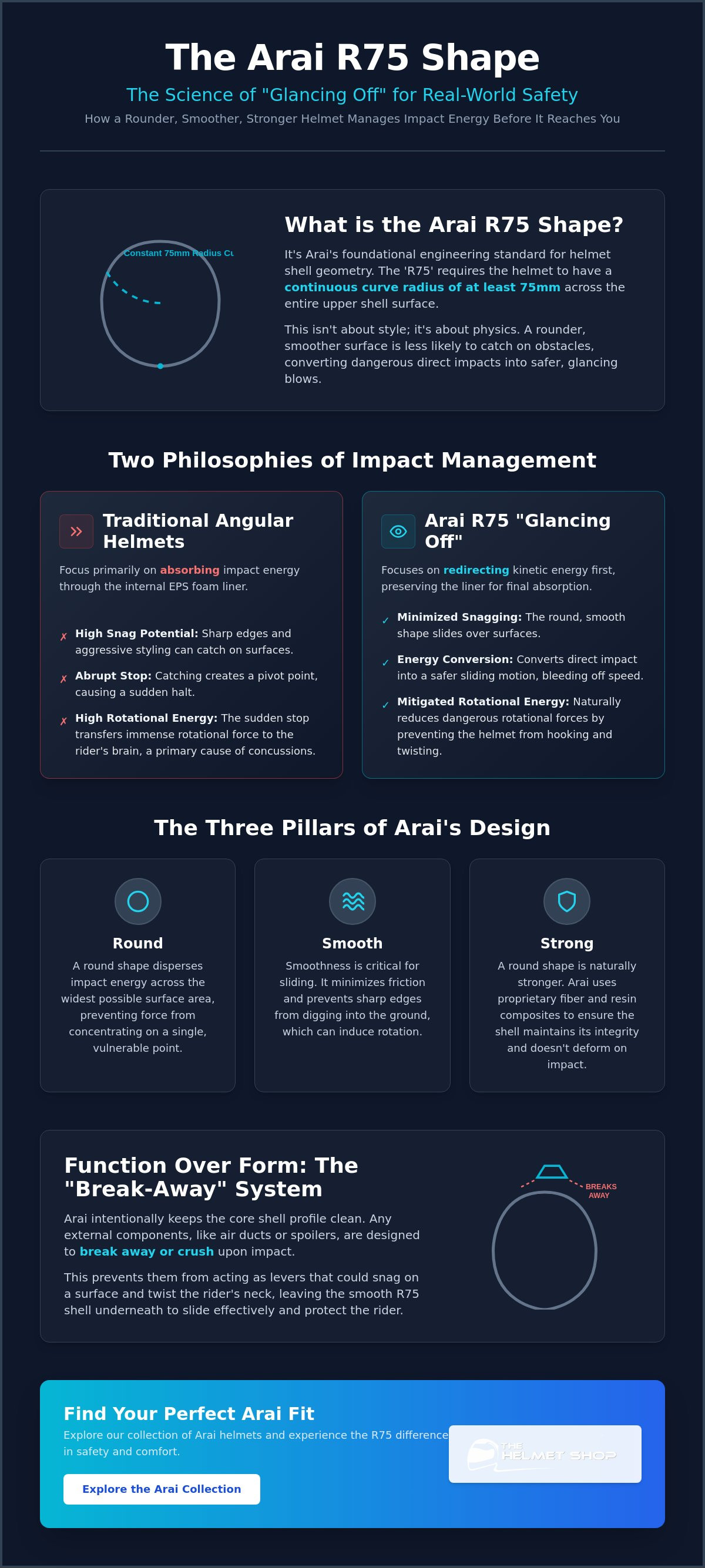
The Arai R75 shape represents a commitment to physics over aesthetics. In the world of motorcycle safety, most brands design helmets to absorb energy primarily through the internal EPS liner. Arai does this too, but they start the process at the outer shell. The R75 criteria requires a continuous curve radius of at least 75mm across the entire shell surface. This isn't just a suggestion or a marketing term. It's Arai’s foundational engineering standard for shell geometry.
Why does this specific measurement matter? A larger radius creates a rounder surface. In a crash, a rounder helmet is less likely to catch on uneven pavement, curbs, or gravel. If a helmet catches an object, it stops abruptly. This sudden stop transfers massive rotational energy to the rider's brain. By maintaining a 75mm radius, Arai ensures their helmets "glance off" obstacles, converting direct impact into a safer sliding motion. It's about managing energy before it ever reaches the internal liner.
The 75mm Radius Rule
The 75mm rule applies to the shell area above the standard test line. While a general motorcycle helmet overview explains that shells protect against penetration, Arai uses this radius to manage kinetic energy. Achieving this shape isn't easy. Modern riders want advanced ventilation and aerodynamic wings. Arai integrates these features as "break-away" components. These plastic ducts sit on top of the shell. During an impact, they snap off instantly. This leaves the smooth, round R75 shell underneath to do its job. Every Arai shell is hand-built by master craftsmen to ensure this precision remains consistent across every model.
Round, Smooth, and Strong: The Three Pillars
Arai bases their design on three specific pillars that make the Arai R75 shape effective in real-world scenarios.
- Round: A round shape disperses impact energy across the widest possible surface area. It prevents energy from concentrating in a single spot that could overwhelm the liner.
- Smooth: Smoothness is critical for sliding. If a helmet has sharp edges or aggressive "styling" lines, those points can dig into the ground. A smooth R75 shell minimizes friction and snagging.
- Strong: A round shape is naturally stronger than an angular one. Arai uses high-density fiber mats and proprietary resins to support this geometry. This ensures the shell doesn't deform or collapse when it hits the ground at high speeds.
By focusing on these pillars, Arai creates a helmet that works with the laws of physics rather than trying to fight them. This design philosophy ensures that the shell remains the first line of defense in managing unpredictable crash forces.
The Physics of "Glancing Off" Impact Forces
Kinetic energy is a relentless force. In a real-world motorcycle accident, a rider isn't just falling; they're moving forward at significant speed. Most lab tests drop a helmet vertically onto a stationary anvil to measure energy absorption. While these tests are valuable, they don't simulate the sliding and tumbling that occurs on the street. This is where the Arai R75 shape becomes vital. By prioritizing a rounder shell, Arai aims to redirect kinetic energy rather than trying to absorb it all through the internal liner.
Traditional helmets often focus heavily on the EPS (expanded polystyrene) liner. This foam is designed to crush and dissipate energy. However, every liner has a finite capacity. Once the foam is fully compressed, any remaining energy passes directly to the rider. The Arai Glancing-Off Theory suggests that the most effective way to protect the brain is to prevent that energy from entering the helmet in the first place. A round shell that slides across the pavement uses the ground to bleed off speed. This keeps the internal liner ready for the final, unavoidable impact.
Direct Impact vs. Kinetic Energy
When a helmet with sharp angles or aggressive styling hits the ground, it risks "hooking" on the surface. This creates a pivot point. The forward momentum of the rider’s body then causes the helmet to jerk or rotate violently. The Arai R75 shape avoids this by ensuring no part of the shell can dig in. It's the difference between a ball bouncing off a wall and a hook catching a ledge. If you're looking for a helmet designed with this level of engineering, you can explore our current Arai collection to find your perfect fit.
Minimizing Shell Protrusions
Arai intentionally keeps the shell profile clean and smooth. Any necessary external components, such as air ducts or spoilers, are made of soft plastic. These are designed to break away under even light pressure. By ensuring these parts detach instantly, Arai prevents them from acting as levers that could twist the rider's neck. This "clean" shell works in tandem with the R75 geometry to maintain a consistent sliding surface. It allows the helmet to perform predictably regardless of the angle of impact. This design provides a safer environment for the rider's head and neck during a complex tumble.
Mitigating Rotational Energy (M.O.R.E.)
Rotational energy is the leading cause of severe concussions in motorcycle accidents. When a helmet strikes the pavement at an angle, the friction can cause the head to spin violently. This rapid rotation causes the brain to move inside the skull, leading to brain shear, where delicate neural pathways are stretched or torn. Arai addresses this through their M.O.R.E. (Mitigation of Rotational Energy) philosophy. M.O.R.E. technology utilizes shell roundness to prevent brain shear by ensuring the helmet slides smoothly across varied surfaces. This proactive approach manages energy at the shell level, providing a critical layer of defense before internal components are even engaged. By focusing on the Arai R75 shape, the brand creates a passive safety system that works with the laws of physics.
The Danger of Rotational Acceleration
Rotational acceleration happens in a split second. If a helmet has catch points like sharp edges or non-breakaway vents, those features act as levers. They grab the asphalt and force the helmet to pivot. This creates a massive amount of torque on the rider's neck and brain. Arai’s design focuses on eliminating these catch points entirely. A smooth, continuous curve allows the helmet to glance off the ground, significantly reducing the twisting forces transmitted to the head. This approach mirrors the brain’s own natural protection, where cerebrospinal fluid allows the brain to slide slightly within the skull during minor bumps. Using the Arai R75 shape ensures that the helmet doesn't become a liability during a tumble.
How Smooth Shells Slide
A smooth surface has a lower friction coefficient when moving across the ground. A rounder surface area slides further and more predictably because there are no flat spots to cause a sudden stop. Some manufacturers use active internal systems like MIPS to handle rotation. While these are effective, Arai believes a smoother outer shell is more reliable in high-speed slides. Internal slip-planes have limited travel, usually only a few millimeters. In contrast, the R75 design provides unlimited sliding potential. It doesn't rely on moving parts that could fail or reach their mechanical limit. According to Arai's R75 concept, a simpler and stronger shell is the most dependable way to manage the chaos of a real-world crash. This design ensures that the helmet remains a stable protective barrier throughout the entire duration of a slide.
Form vs. Function: Why Arai Prioritizes Shape Over Styling
Riders often ask why Arai helmets don't look as aggressive as some competitors. In a market filled with sharp lines and deep ridges, Arai sticks to a classic, rounded profile. This isn't because they're behind the times. It's because they refuse to pay the "Style Tax." When a shell features integrated spoilers or sharp styling lines, it creates catch points. These points can snag on the pavement during a slide, causing the helmet to rotate or jerk. Arai avoids this by strictly adhering to the Arai R75 shape, ensuring that every shell is as smooth as possible.
Aerodynamics are still a major focus for the 2026 collection, but Arai handles them through external components. By keeping the shell round, Arai ensures that safety remains the primary function. If you're curious how this compares to other high-end manufacturers, you can explore the design philosophy of Shoei Helmets to see how they balance premium protection with modern aesthetics.
The Myth of "Aggressive" Aerodynamics
Many riders believe that a helmet needs a complex shape to be stable at high speeds. Arai proves otherwise. They use plastic vents and spoilers that are designed to break away under minimal pressure. These parts are not structural. During a crash, they snap off instantly, leaving the round shell to glance off the ground. This approach provides excellent wind management without the safety risks of a permanent ridge. A rounder shape is also more neutral. It performs well whether you're tucked on a track day or sitting upright on a touring bike. This versatility reduces wind noise and prevents the "buffeting" feel common in more angular designs.
Snell Standards and R75 Synergy
While basic DOT and ECE 22.06 requirements are mandatory, Arai treats them as a floor, not a ceiling. The Arai R75 shape is particularly effective at passing the Snell penetration test. A round surface is naturally better at deflecting sharp objects than a flat one. This geometry ensures the shell stays intact even when facing extreme localized forces. Arai’s commitment to this shape means they don't have to add excessive weight to pass these tests. The strength is built into the geometry itself. If you're ready to invest in a helmet that prioritizes your brain over a trend, check out our full range of Arai helmets today.
Choosing Your Arai Helmet: Fitment and Models
Selecting the right helmet requires balancing the external safety of the Arai R75 shape with your specific internal head geometry. While the shell remains round and smooth to manage glancing-off forces, the interior is customized to provide a secure, comfortable fit. A helmet that doesn't fit properly won't stay in the correct position during an impact, which could compromise the effectiveness of the shell's design. This is why professional fitting is essential to ensure the helmet performs exactly as the engineers intended during a slide or tumble.
It's vital to remember that a premium helmet is an investment in your long-term health. While Arai focuses on a specific safety philosophy, other brands offer different approaches to the market. For instance, you can look at HJC Helmets as a high-value alternative if you're looking for a different balance of performance and price points. However, for those committed to the glancing-off philosophy, Arai remains the gold standard.
Finding the Right Internal Fit
Arai is one of the few manufacturers that offers three distinct internal shapes to match different riders. The Corsair-X is their flagship racing model, featuring an Intermediate Oval fit that works for the majority of the riding population. If you have a head shape that is significantly longer from front-to-back than side-to-side, the Signet-X offers a Long Oval shape. Conversely, the Quantum-X provides a Round Oval fit for riders with a wider head profile.
The brilliance of this system is that the exterior Arai R75 shape remains a constant engineering standard across all these models. The shell's ability to redirect energy doesn't change just because the interior pads are shaped differently. To find your size, measure the circumference of your head at the widest point above the ears. Use these measurements as a baseline, but always try the helmet on to ensure there are no pressure points on your forehead or temples.
Arai as a Long-Term Safety Investment
Buying an Arai means you're investing in a piece of equipment with a 5-year warranty from the date of purchase. These helmets also have a total useful lifespan of 7 years from the date of manufacture. This longevity is a direct result of the hand-built craftsmanship and high-quality resins used in every shell. Each technician who works on a shell signs it, taking personal responsibility for the safety of the rider who will eventually wear it.
For the safety-first rider, the R75 philosophy offers peace of mind that standard lab tests can't fully capture. It's a design that respects the chaos and unpredictability of the road. By choosing a model that fits your head shape perfectly, you ensure that Arai’s decades of specialized engineering can protect you when it matters most. Don't settle for a helmet that just looks fast; choose one that is built to slide.
Invest in Proven Protection for Every Mile
Choosing a helmet is one of the most critical decisions a rider makes. The Arai R75 shape provides a unique level of safety by prioritizing energy redirection over simple absorption. By maintaining a smooth, round shell, these helmets minimize catch points and mitigate the rotational forces that cause serious injury. This design philosophy ensures that your gear works with the laws of physics to keep you safe in unpredictable real-world scenarios.
Whether you need a long oval or round oval fit, finding the right interior shape is just as important as the exterior engineering. Proper fitment ensures the glancing-off technology performs at its peak. As an Authorized Arai Dealer, we provide expert fitment advice to help you select the perfect model for your needs. You'll also enjoy free shipping on premium helmets when you order through our store.
Shop our full collection of Arai Helmets at The Helmet Shop and experience the difference that hand-built craftsmanship makes. Ride with the peace of mind that comes from knowing you're protected by world-class engineering on every journey.
Frequently Asked Questions
What does R75 mean on an Arai helmet?
R75 indicates that the helmet shell maintains a continuous curve radius of at least 75mm. This specific measurement is Arai's internal standard for ensuring the shell is round and smooth. By avoiding sharp angles or flat spots, the helmet is less likely to catch on the ground during a crash. This design allows the helmet to slide, which is the most effective way to manage kinetic energy.
Does the round shape of Arai helmets make them less aerodynamic?
No, the round shape doesn't compromise aerodynamics. Arai uses a neutral profile that remains stable in various riding positions. They manage high-speed air flow using external plastic vents and spoilers that are designed to break away during an impact. This allows the helmet to be stable at track speeds while keeping the structural shell round and safe for a slide.
Why are Arai helmets rounder than other brands like Shoei or HJC?
Arai chooses this round profile to prioritize "glancing off" over aggressive aesthetics. While other manufacturers might use sharper shell lines for styling or integrated aerodynamics, Arai believes those sharp edges can act as catch points. By sticking to a rounder geometry, Arai ensures the helmet performs predictably regardless of the impact angle or surface texture.
How does the R75 shape help in a motorcycle accident?
The Arai R75 shape works by redirecting impact forces rather than just absorbing them. In a real-world slide, a round shell glances off uneven surfaces like curbs or pavement. This prevents the helmet from "hooking" and causing the rider's head to jerk. By sliding instead of stopping, the helmet protects the brain from the violent rotation that often causes severe concussions.
Are all Arai helmets made with the R75 shape?
Yes, every full-face and open-face helmet produced by Arai follows the R75 criteria. This isn't a feature reserved for their racing models. Whether you're buying an off-road helmet or a touring lid, the core philosophy remains the same. Arai believes every rider deserves the same level of glancing-off protection, regardless of their specific riding style or budget.
Does the Arai R75 shape help with wind noise?
Yes, the smooth shell helps reduce wind noise by minimizing turbulence. Sharp ridges or aggressive styling on other helmets can catch the air and create whistling or buffeting. The R75 design allows wind to pass over the surface more smoothly. This creates a quieter environment inside the helmet, which reduces rider fatigue during long trips on the highway.
Can I install a Bluetooth headset in an Arai R75 shell?
You can easily install a Bluetooth headset in an Arai shell. Models like the Corsair-X or Signet-X feature removable cheek pads and dedicated speaker pockets designed for modern communication units. While the external shell stays smooth for safety, the internal EPS and liner are engineered to house these devices without affecting the helmet's fit or comfort.
Is the Arai R75 shape better for rotational energy than MIPS?
Arai handles rotational energy at the shell level, while MIPS uses an internal slip-plane. The Arai R75 shape is designed to prevent the helmet from catching on the ground in the first place. Arai believes this passive approach is more reliable because it doesn't rely on moving parts or have a limit on how much it can slide. Both systems aim to reduce brain shear during a twist.


